Ah, here we go, yes, heat treated cone, surely they will have made thousands and surely some are faulty.
http://www.gkndriveline.com/drivelinecms/export/sites/driveline/downloads/datasheets/Super_LSD.pdf
Ah, here we go, yes, heat treated cone, surely they will have made thousands and surely some are faulty.
http://www.gkndriveline.com/drivelinecms/export/sites/driveline/downloads/datasheets/Super_LSD.pdf
I have just had an email from VOSI:
"All three MOT brake tests were carried out using a Roller Brake Tester.<o:p></o:p>
<o:p> </o:p>
VOSA Information Access Team"
More grist to the mill?
<o:p> </o:p>
Hello Paul and others,
Following your post yesterday I too emailed the VOSA address Tone had given and recd a very quick reply this morning.
Our car has had 4 tests by 2 different garages and we have the certs so I was able to send all the test numbers.
The reply was,
“Dear Richard
The information entered on the system by the garage(s) that conducted these
tests all show that an RBT was used.
VOSA Information Access”
So either the info about our car having an LSD is not showing up at the test centres or the testers are ignoring it.
I’m still awaiting new oil to arrive and will then have it changed to see if there are any bits in it.
Richard,
VOSA can / will also tell you if the LSD information is shown against your vehicle in their database, and hence available to MOT stations…
Martin
Thanks Martin, I’ve emailed them again to ask that, and the oil has arrived this morning so will keep you posted…
as you say, dont know if this problem can be attributed to mk3s. mines a 2 ltr with lsd. i havent seen any bits in oil when changed. but when i stop at traffic lights with slight down hill slope in the mornings, i notice a gentle clunk from diff when i engage gear. not always. but quite often.
clutch pedal is well down. maybe its a slight drag on the clutch??
anybody elses similar???
steve
Looks like I am joining the long list of people taking the radical weight saving step of removing weight from the differential internals  . Found this yesterday as part of a major service.

2003 Mk2.5 Sport with 99k on it if anyone is keeping track. Diff oil last changed at 74k, but I have only got the car recently so cannot comment on whether pieces have been found previously.
Martin
Hi Steve,
Mine too is 2 litre Mk3 with LSD and there is some drivetrain chatter sometimes. These cars are known for some slack, I read it somewhere (on this site?) a memo from Mazda saying it was usual.
A lateral thought; it’s downhill so if you take your foot off the brake/release hbrake just before engaging gear the car may sometimes be rolling forward a little and the diff would start to drive the gear train. When the gear was then engaged it might then clunk as it took up the slack in the drivetrain thus caused.
A dragging clutch could also be the reason as you say. With the hood up in a quiet street, or better a garage, and the car in neutral idling, just dip the clutch slowly and release it slowly listening carefully. There is a surprising amount of noise to be heard as the clutch releases the gbox mainshaft then engages it and the clutch bite point can clearly be heard. If you do not get a noise change by dipping the clutch in neutral it may be because the clutch is dragging and the mainshaft is always rotating til you select a gear. Dip it and select a gear to see if this is the case. If it then goes quiet it may show the clutch is dragging as selecting the gear will stop the mainshaft rotating. Release the clutch slowly (be prepared for the car to move) to check the bite point which may be down on the floor. Maybe bleed the system as next step but my bet is that all is ok and the occasional clunk is from drivetrain slack.
Martin, I’m gutted for you, there is clearly something very wrong going on here 
I would (am in the process of myself) email VOSA and ask if your car is 1) recorded as having a LSD and 2) whether a RBT was used on the MOT tests.
I’ve had a reply as below and will let you know the outcome.
"FREEDOM OF INFORMATION ACT 2000<o:p></o:p>
<o:p> </o:p>
I refer to your e-mail <st1:date year=“2011” day=“2” month=“11”>2nd November 2011</st1:date>. We are dealing with this under the terms of the Freedom of Information Act 2000. <o:p></o:p>
<o:p> </o:p>
The Act gives a period of 20 working days for response by the public authority holding the information. This period may be extended where a ‘public interest test’ determination needs to be sought. We will contact you again if it is necessary for a time extension to be made.<o:p></o:p>
<o:p> </o:p>
In some circumstances a fee may be payable and if that is the case, we will let you know the likely charges before proceeding.<o:p></o:p>
<o:p> </o:p>
If you have any queries about this letter, please contact us, quoting reference…"
All,
There is certainly an issue with MOT testing in that my car at least has been tested 4 times on RBT in contravention of VOSAs testing instructions. I hope to get an explanation of this be it a lack of communication from Mazda, VOSA or the MOT stations, or that the communication system was not in place when my car was regd in 2005 and first tested 2008, etc, etc.
Whether RBT is a cause of failed LSDs is another issue.
Can I ask anyone with an LSD car to let us know if;
with one rear wheel jacked up from the ground, and the other still on ground, in neutral, handbrake off, the raised wheel can be turned freely in both directions.
I think the fundamental point here is regardless of whether the RBT damages the diff or not, it is up to us as owners to ensure the MOT station understand how important it is not to RBT our LSD equipped cars.
I had a chat with a friend of mine who is an MOT tester this weekend, and he told me three useful things:
The tester is bomarded with information from the MOT computers at the start of an MOT test, whether a car is LSD equipped or not may well get lost in that mass of information.
The alternative to the RBT, the decellerometer test, takes much longer to perform than the RBT. The tester has to get the car out of the workshop, find the decel equipment, go on a test drive etc rather than the quick, almost automated RBT.
The RBT can diagnose brake faults on individual wheels, the Decel test cannot. Therefore, the RBT is considered a great diagnostic tool by my friend at least.
I guess what I am trying to say, is we should make it very clear when booking the MOT, and dropping the car off, we do not want our LSD equipped cars on the RBT.
Martin.
Hi Rich,
Not heard from VOSA yet if my MX is logged as having an LSD fitted, but results of my findings. Checked on gravel and the LSD seems to still be working OK.
With both rear wheels clear of the ground if one is turned the other goes round the same way, with one on the ground [in neutral, h/brake off] the other turns freely, also tried it [whilst being exstremely careful] in 1st with the engine at idle and no sign of the LSD trying to lock, the wheel still turned freely!!!. If my findings are typical, my conclusions from this are that whilst the RBT should not be used with an LSD, the speed the rollers go at should not have caused my diff failure.
Background info:- 3 MOT’s using RBT before diff failure.
2 MOT’s using RBT and 1 using decellerometer [I informed them] with new diff.
I don’t think the test you did has any relation or bearing on the RBT test. The issue is with the power the motors put into the diff when one wheel is locked (ie when the brakes are being applied). The motors which turn the rollers are VERY powerful, and all that power is being fed into the diff (LSD unit) from the ‘wrong’ direction (ie from the driveshaft). It’s very common in engineering generally for a component or system to be very strong in its ‘designed’ direction but weak when subject to a force it was not designed for. And that’s what we have here.
Hi, it was myself who first speculated the cause of the partial differential failure could be due to roller brake testing back on page 2 of this thread, the main reasoning behind this was that Mazda denied having any partial or total Fuji Super-Diff failures within the initial warranty period, this of couse neatly coincides with the first MOT requirement for cars in the UK at 3 years from first registration. Couple that with the shockingly bad design of these plates and its pretty obvious what is causing the tabs to shear off…
I have just looked at a Eunos Roadster RS Limited Torsen Type II 4.300: 1 diff which I have here (available if anyone wants to make a serious offer for it) if I rotate one output flange the other output flange rotates in the opposite direction. If I hold the other flange with my other hand then the one I previously rotated will lock and cannot be rotated.
Dr. Eunos
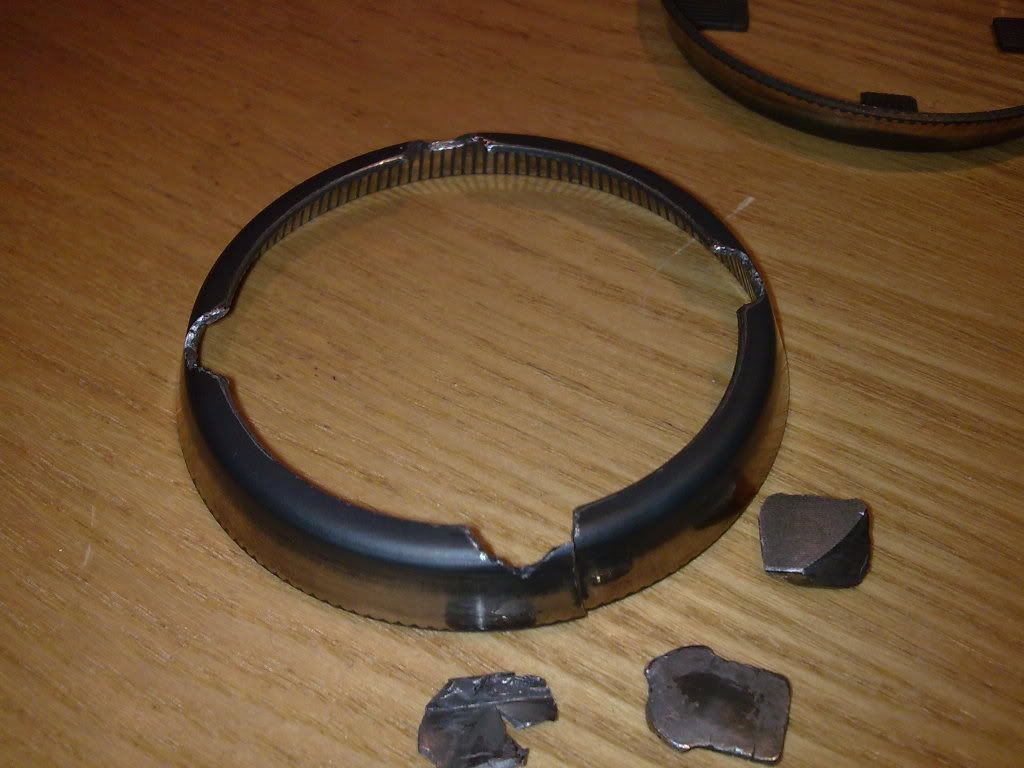
Here are a few photos of the failed components from a Fuji Super-Diff NB note the cracks at the end of the pen on the other plate, showing it was also just about to fail, the large thicker lump of pinion tooth could certainly cause a complete lock-up of the rear wheels…


Dr. Eunos
I’ve just had a reply from VOSA as below -
DATA PROTECTION ACT
1998
I refer to your e-mail of 4th
November 2011. We have dealt with your
request under the terms of the Data Protection Act 1998.<o:p></o:p>
You asked if details logged against your Mazda MX5 shows that the vehicle has a LSD (limited slip differential )fitted.
VOSA do not log this information against individual
vehicles so we are unable to help with your enquiry.
Not a very satisfactory outcome!!! looks like it’s down to owners [particularly of MK 2.5 sport vehicles fitted with an LSD] informing the Test Station - Wish I’d known about this situation when I purchased the vehicle as it could potentially have saved me a packet …
Tony
Hi Tone, All,
Many thanks for the replies.
My findings are the same as Tony’s but I wanted confirmation from someone actually trying it without me saying it first, thank you for that.
- This car’s had 4 RBT MOTs. On Sat I changed the diff oil at my local friendly garage where he guided me onto the ramp and left me to it. Big relief, no swarf or bits at all, just dark grey/black oil and grey paste on the drain plug magnet. Poked around inside with my little finger and some wire but couldn’t find anything. Oil looked like I’d expect 30K miles oil to look like (40 years xp of cars/bikes) and full history file with parts receipts makes no mention of oil change. Got exactly 600cc out into measuring jug which is well below the fill plug level. No leaks apparent so probably been filled by measurement. So, hopefully, that was the first change without a problem but I don’t know what damage may be yet unknown and will change it again next year.
I’ll also continue with the VOSA enquiries.
Tony, yours is a strange reply from VOSA, they appear to be saying,
we have never logged (any) LSD against (any) vehicles, or
we did not log LSD against the vehicle at that time of registration, or
we do not/any longer/nowadays log LSD against the vehicle.
If I get a similar reply I will certainly press for clarification.
All the best,
Rich
The speed of the rollers has no bearing on the potential to cause damage to an LSD, its the torque and momentum in the roller drums feeding power the wrong way i.e back into your diff from the roadwheels, as our former chairman indicated earlier intimated - a mechanism can be very strong when working in the power-flow direction for which it was originally designed, and very weak if torque is transmitted the wrong way back through the said mechanism.
TorSen derived diffs, work quite differently to Salisbury and viscous types in their operation, to my mind they are inherently more likely to suffer damage on roller brake testers than most other types.
My own Eunos Roadster V-SpecII has a TorSen diff and I am certain that every one of its 10 UK MOTs has been carried out on an RBT machine, luckily the type on my car does not seem to suffer the same destructive fate as the Fuji Super-Diff that this particular Mk2 -2.5 age range is affected.
Dr.Eunos
Hi Taff, all,
That wasn’t my conclusion about the rollers, it was Tony’s, but my findings about the jacked up wheel agree with his.
My thoughts, for what they’re worth, are that first we understand how this SuperLSD works. Let’s get away from any “Torsen” labelling. It does not sense torque and apply it in any particular ratio between wheels as a helical Torsen does. It works by connecting the 2 wheels together by greater or lesser friction when the prop applies more or less load.
Thus, if you boot it the 2 wheels become more connected together and if you ease off they become less connected. If one wheel is free to spin such as on ice or jacked up there is no load, the LSD can’t operate, and the drive is lost through the slipping wheel. It’s not a locking diff at all and the max extra torque is quoted at 2.1 times.
It’s really an ordinary diff with a couple of cone friction plates betwen the diff gears and cage. The only way I can see it working is that torque through the prop, resisted by grip from the roadwheels, causes the diff pinion teeth to ride out of the diff gears and so press them onto the cone friction plates. When the torque from the prop is reduced the pressure on the friction plates is reduced. If the teeth are symetrical I think it will also work as a 2 way LSD to some extent on the over-run.
Without load on the prop there is no locking effect. Rotating a roadwheel on the rollers with the car in neutral will not lock it, the prop is not loaded and will just go round like a regular diff.
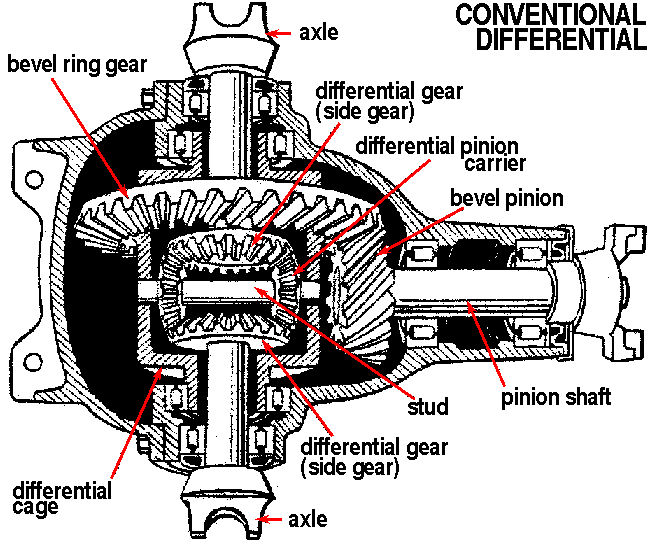
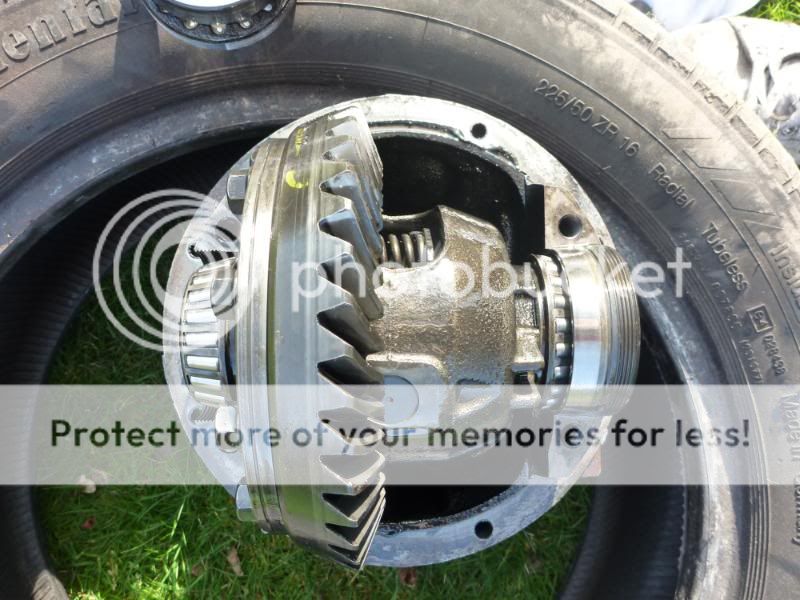
Pics below are regular diff, followed by SuperLSD unit. Look carefully into the second pic and we see it is just the cage, pinion and diff gears with cone plates which bolts to the ring gear. The case of the SuperLSD is the diff cage and the diff works the same as the regular diff with just those cone friction plates causing the 2 axles to bind together under load as the pinion teeth ride out and press the diff gears onto them. At the bottom is Ollie_247 pic of the SuperLSD bolted to the ring gear showing the preload sping (and hole though which those tabs come out).
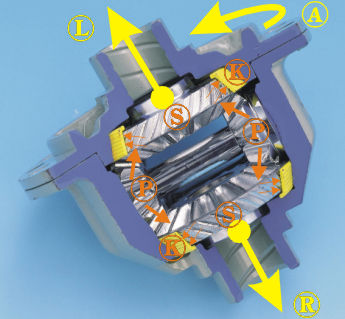
There may be some preload applied from the coil spring we see in Ollie_247 picture below, but with an unloaded prop this should just give a little drag which is what I felt on testing, and cannot “wind itself on” in any way if the prop is free. Just my thoughts though and any comment welcome.