I’m looking for technical help or recommendations on: BATTERY CHARGING__
Hi-I have a CTEK battery charger-should I remove the battery for charging or can I simply connect to the battery in situ?I remember someone warning me to disconnect before charging to avoid a problem with the electrics.
Leave it connected and wait for the cold weather to go!
They are designed for leaving connected etc.
I would suggest connecting to the chassis earth as opposed to the battery negative.
Mine stays on for the winter👍
Why does the negative need to be on an earth of the car and not the battery?
Where is a good earth?
Does a trickle charger need to be earthed to the car instead the battery?
In “the main” it’s recommended because of sparking and safety.
Also many modern cars with complicated electronics (in particular stop/start) recommend you never use the negative terminal to jump start or charge the battery. In particular Volvo and many others.
Components can be damaged.
Mazda NC also stipulates not to use the negative terminal to jump start on the flat battery. The manual shows where to connect and can obviously be used to connect the negative lead of the CTEK.
The hand book will advise how to do this on an individual car. A fair few recommend the metal engine mounting bolt to chassis.
A simple test meter will confirm a good ground point.
As I said above I never use the negative terminal.
Others I am sure will have a different opinion perhaps.
I’ve kept my battery good for years with a tender over the winter months. I’ve never grounded the negative to anything, always to the batt neg. The MX5 isn’t a canbus electrical setup, so there’s really no need to over complicate a simple procedure. Just my experience.
Lots of smart chargers come with permanent fixture connections options for the battery, so cant see it been a problem otherwise they wouldn’t sell them.
They are handy, and for a simple old fashioned battery in an older car are OK, especially since it is usually a “splash-proof” connector, and the operator is meant to connect this first before plugging the charger into the mains.
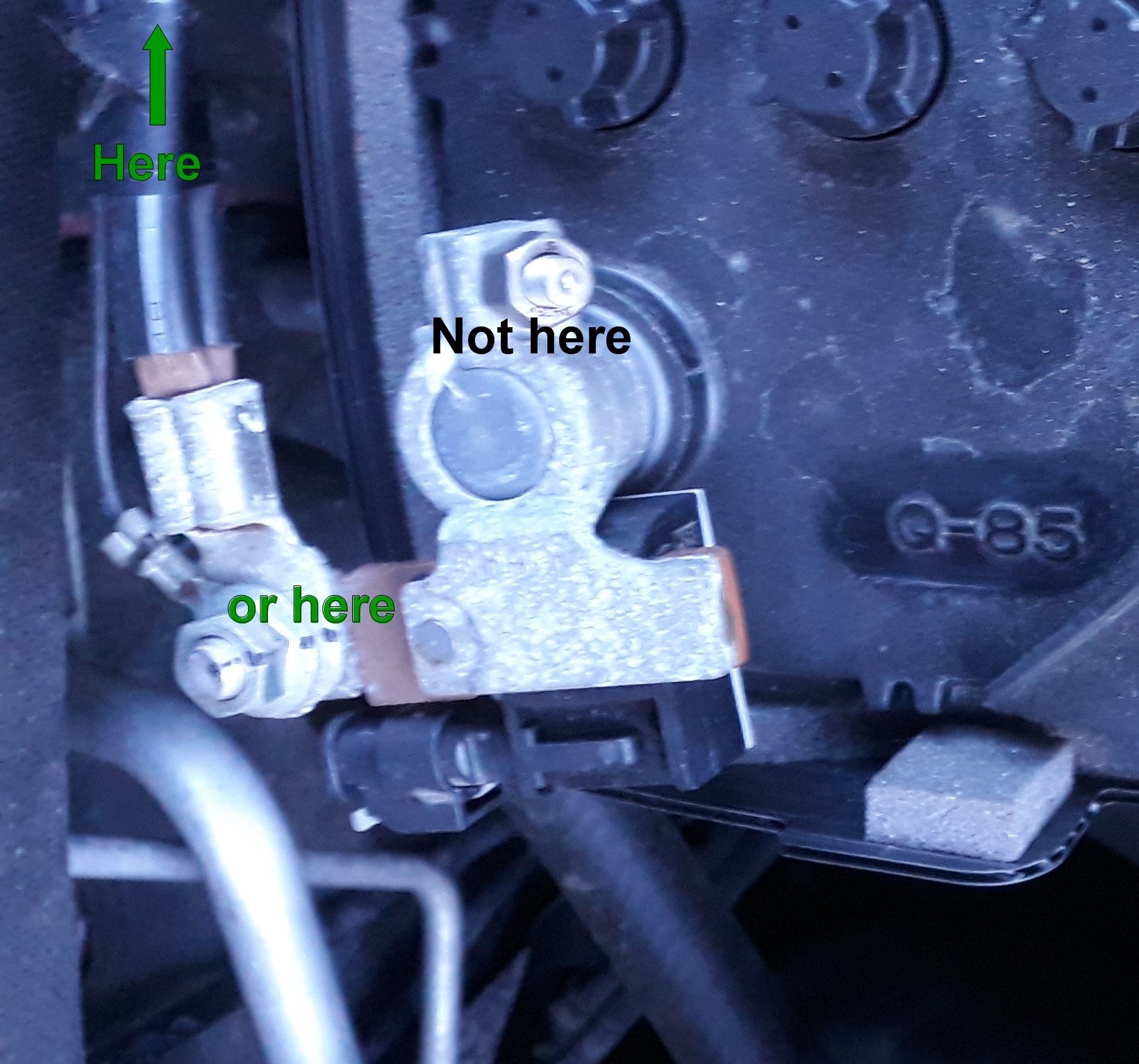
However, as has been pointed out, some batteries (eg EFB Start/Stop) need a charge control system, essentially an over-current limit to protect the more delicate high-density electrode structure from local boiling. The wiring to chassis usually includes a current sensing element. In this case it would be advisable to connect to the chassis end of the earth strap or at worst the chassis side of a -ve terminal that includes the current sensor, but not to the clamp bolt. As indicated in this picture of a Q85 Stop/Start battery (car with i-Stop but no i-Eloop).
Isn’t that the reason to use a smart charger over a standard charger it takes care of over current, obviously only using a charger that has AMG setting. EFB can be charged in normal mode.
My Kadjar that is stop start just quotes positive to positive negative to negative. I know my Astra K recommended Negative to earth bolt which they added to the side of the the engine bay but that was only because the battery was in the boot.
If you look closely at my picture above of the earth terminal, you’ll see there is a bit of copper going between the strap bolt and the battery terminal clamp, and under the copper is a small circuit board with another wire plugged into it and clipped to the strap. That small assembly is the current sensor.
Looking at the various battery manufacturers websites, for EFB they all recommend constant current for a limited time depending on initial resting battery voltage. Many suggest 4Amps as that current.
Mazda use a higher current from their workshops special charger, but again for a time limit based on the starting voltage.
In the car the current monitor system knows how much has been used on a start, or just sitting running stuff without the engine turning, as well as how much is being put back.
If the battery is supposedly full (having done the sums and looked at initial rest voltage) then the alternator supplies just enough to run the car without charging the battery - this saves fuel and does not cook the battery with wasted charging. In theory this is a Good Thing.
Unfortunately this does not take account of the self-discharge and dark current over several months.
When I recharged the Mazda3 after standing still for more than six weeks it took overnight at 3.5A before my Noco Smart charger thought it was full, and this is a 65AH battery. After a few journeys of about half an hour each the iStop system eventually caught up and began to work normally.
In the old analogue TV days there were three main colour systems. Each had an acronym, with official meaning, and as one might expect, a more common unofficial phrase used by the engineers working with them.
First was America with NTSC, “National Television System Committee”, or “Never Twice the Same Colour”
Then came France with SECAM, " Séquentiel couleur àmémoire", or “Sepia Eternally, Contrary to American Method.”
Finally UK and Germany invented PAL, “Phase Alternate Line” or “Perfect At Last.”
Thank goodness for digital.
All getting far too complicated for me !!!
My CTEK charger has two crocodile clips-if I connect both to the battery,WITHOUT REMOVING THE BATTERY TERMINALS will this cause any problems or is it best to disconnect the battery terminals first?
Cheers