- My model of MX-5 is: 1990 NA
- I’m based near: Chesterfield
- I’m looking for technical help or recommendations on: Stuck Horn
I suck at electrics, so any advice please take slow.
Was driving down the road last week when my lights popped up/down randomly. After that, I noticed my horn had failed. I did the usual tests, brake lights didn’t work, the fuse had gone.
I’ve replaced the fuse. However now, the horn is stuck on. I did some research and replaced the relay (on passenger side engine bay), which didn’t work. So I’m assuming I have a ground fault somewhere, somehow.
I fitted a new intake a few days prior to this happening, however I had the car running for a good number of hours doing the burps filling coolant, and even had it on the road the day before without any issues. So I don’t want to think it’s that, even though that is the only thing that’s changed in the engine bay recently.
I could do with some advice, explanations or someone in person to lend a hand if possible.
I don’t have any equipment for electrics (voltmeter etc.)
I have until Friday to get this sorted as I’m back in another part of the country for work. So I have no qualm getting a professional to look at it. But would prefer to save some money.
I’ve done some digging.
I’ve gone from the intake forwards as that’s the latest change that’s been made. Insulated all areas that could be a cause.
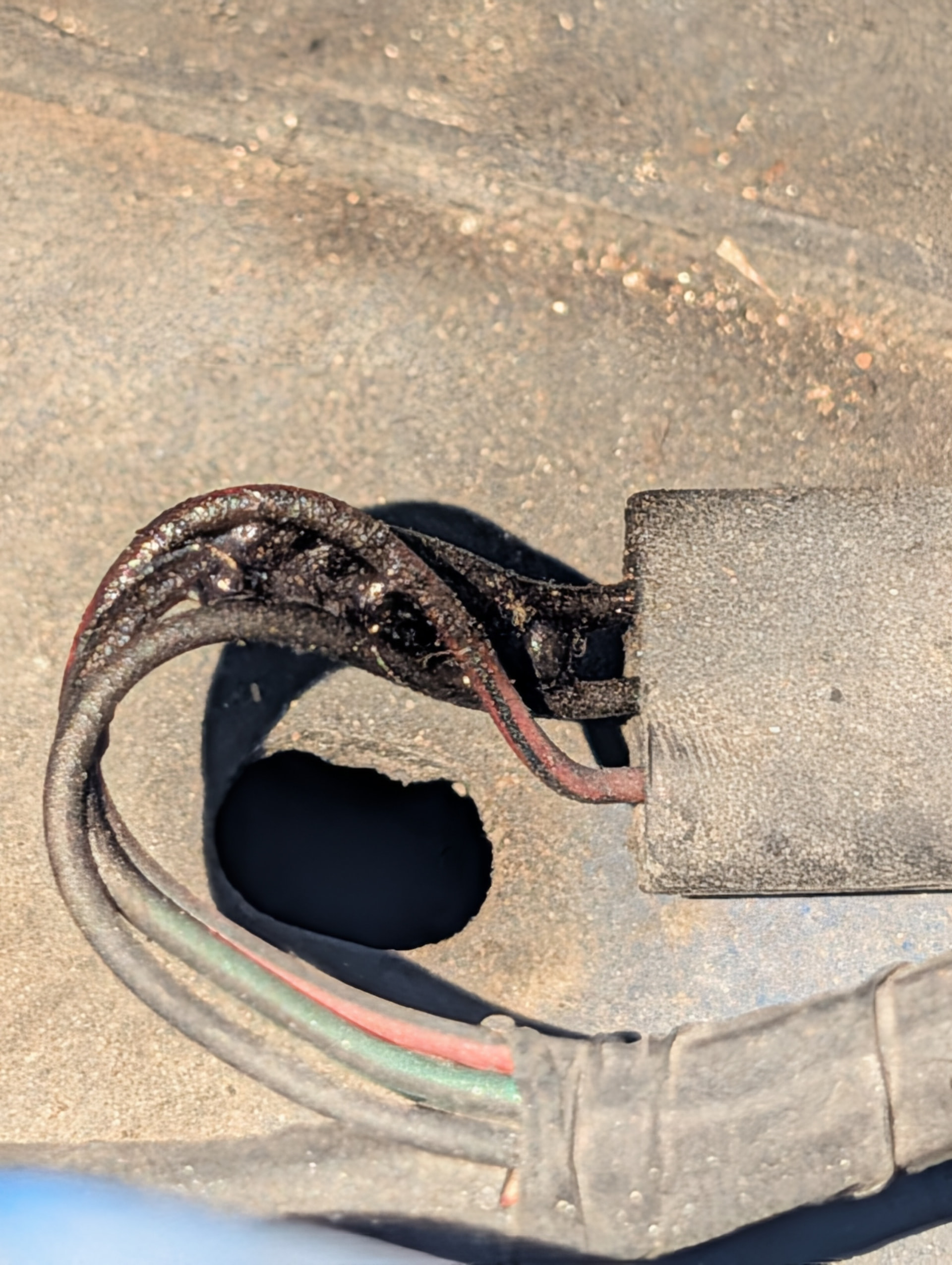
I think I’ve found the issue, but someone engineer-y might need to confirm:
That is the loom going to the horn just after it splits from the radiator fan. It’s situated directly underneath the passenger headlight.
To me, it looks like it’s shorted out. Am I correct?
I don’t have a solder or anything, just tape. My plan is to try clean it up and wrap the wires. Any other fixes I could try?
Are there bare wires? I don’t see damaged insulation, just oil and grime. One way you can find out for sure is to run a continuity test at the connector with a voltmeter. With the car off there should not be any continuity between any of those 3 wires. Horns generally work like this(most cars):
They are one-wire circuits…this wire is always 12v+ hot at all times. The case of the horn is grounded to the chassis of the car. The steering-wheel side of the circuit has a wire running to the clockspring(this is a ground wire) then through the clockspring and grounds out on the frame of the steering wheel. What actually completes the circuit is the airbag housing being pushed down so it contacts and bridges the frame of the steering wheel and the wire running through the clockspring. If its stuck on, it can only mean that a spring holding the airbag housing up in normal circumstances has weakened or broken so that the frame is always bridged. This seems unlikely to me(possible I suppose)…its more likely you have an aftermarket steering wheel with on of the paperclip-looking wires that grounds the horn through the hub instead of through a factory clockspring. All this assuming of course that there really isn’t a short in the wiring you showed.
I cleaned up those wires. Just dirt and grime as you said. Nothing wrong with them.
I insulated and separated them anyway.. before I realised they were the wires for the headlights, not the horn..
I have a Nardi Torino wheel. Same one that came with the Eunos. Mine is a UK spec, so I’m unsure which wheel it would’ve come with as standard, but yes, it has the singular RED wire coming through the hub and connecting to the button.
I’ve taken the button off, and touched that wire against the inside of the hub, horn still goes off. So I am pretty sure the button isn’t broken and it must be a ground fault somewhere.
Problem I have now is, everything is tied together in one massive loom, wrapped in electrical tape. So I can’t trace the wires to the relay, not do I know what to look for.
I don’t know how drastic I’m being when I say that I don’t want to rip my entire interior apart just to follow a single wire. Especially when for all I know it could be a ground fault literally anywhere possibly not related to the horn circuit.
I don’t fully understand electrics, and I wasnt really ready to learn yet
So when you disconnect the horn button the horn stops sounding yes?
It sounds to me like you have the cone shaped spring upside down on the horn button. The small coils should be against the plastic button.
Sounds like a problem with the button to me then. You’ve kind of proved the horn circuit is OK by grounding the wire.
I was about to come on and act all proud of myself by saying “the horn isn’t on permanently when the horn button is removed so it must therefore be the button, not a ground fault”
But reading the replies, you’ve beaten me to it.
It’s what I’m having a bash at right now while I have a shower (multitasking). As it’s been mentioned in a previous reply, I currently have the wider part of the cone-shaped spring facing the plastic button, simply because that’s what it looked like fitted properly.
I’ll swap it and see what happens. Everything else seems fine - if you discount the fact the retaining spring is keeping me honest by REFUSING TO STAY OUT WHILE I CLIP ON THE OTHER SIDE!
I shall post my verdict
So the conical spring was the wrong way round…
Basically, it was a self-inflicted issue because I trusted myself to build a 4-piece assembly correctly - yet somehow didn’t 
Glad you got it sorted in the end. 
Don’t feel too bad. “Finger trouble” happens all the time, and to anyone!
I did two decades in front-line electronic maintenance. About 10% to 20% of weird faults turned out to be a consequence of “finger trouble,” and this was almost equally split between either us engineers or the users (often coffee in the works).
How do I know? We had a long standing ‘fault chit’ system as a running check on equipment reliability and down time. The chits also detailed diagnoses and cures. One of my last tasks before I moved on (why do you think I moved on?) was to do a statistical analysis of these chits!
That used an early spreadsheet (maybe PlannerCalc?) on a CP/M system. Snail slow compared with a modern PC, but ever so much quicker than pencil and paper. The “Brand Reliability” and “Heavy-handed User” stats were revealing! Management loved the FX80 print-outs.
An expensive real-world example is an early Mars Orbiter that crashed into Mars because of a metric-imperial confusion on final course adjustment. This now very hard to find artist’s impression of it became my desk-top wallpaper for a couple of decades as a reminder to check everything twice! And yet again before final release!