The October issue of “Car Mechanics” has an interesting feature on which makes (and models) rust and which don’t, based on cars up to 15 years old. In general they express disappointment that rust, which seemed to be on the way out in the 1980s, is again a consideration on many modern cars.
Mazda gets a pasting, the 6 and MX-5 in particular (the MX-5 is described as a potential “death trap” because, as we know from the Mk2 front chassis rails, it’s not just cosmetic), as does Nissan. Older VWs were also dreadful but since they started galvanising all VW Group bodies the problem has gone. The BMW E46 was a dog (I had one for a bit; it must have been the cleanest 11-year old one going, since all the others I looked at had rotten rear arches). Land Rovers are crap and we are told to remember that they’re still basically a BL product
The surprising winners: all French makes. None of them rust any more, even the cheapest Citroens. They’re not reliable but the bodywork lasts for ever.
The source data came from car forums on the internet and about 300 scrapyard cars they looked at. I wondered why they hadn’t used MoT failure data, which is publicly available, but I suppose this is self-selecting; no-one welds an old Astra worth £150, but an MX-5 of the same age may well be repaired to keep it on the road. However they did it, it all rings very true.
I used to desire a Montana before the Mk 3 came along … I even offered £12,000 for a secondhand one - the offer was declined by the Mazda dealer in Horsham.
I’m thinking I may have had a lucky escape - imagine if that had rotted out the running rails?! The loss would have been horrific for a car which would only have done 1,500 miles a year!
This rust thing is extremely worrying - I’m just hoping that we are hearing loud messages from just those affected and the majority are absolutely fine?
VW’s not rusting tell that to the MK5 owners…and some Audi owners with rotten wings.
Furthermore, irony is our Nissan Micra is 10 this year no rust to be found.
Recently found rust developing where underseal was on our 2.5 year old Volvo C30…not completely undersealed.
Fact is many manufacturers are over reliant these days and in some cases becoming blase about the issue underneath. I mean finding actual rust and flaking underseal on a 2.5 -3 year old Volvo!
My 16 year old Mk1 is undersealed and I have done my rear arches by hand. Sills seem ok: no drama. 130,000 miles on clock. God knows what the drain holes etc etc are like…but all seems ok for now!
I have recently had my MK 2.5 Indiana across to Mx5 Motors, where Steve repaired my rear sills for a reasonable sum of dosh. I bought it in the snow of January and once the weather improved made a good check of it, noticed some rust bubbles on the rear sills. I took it over to MX5 Motors and Steve put it up on the ramps and they weren’t too bad, the chassis rails were fine. I told him that I would have them sorted in September when I was going on holiday. So yes there is an issue with rust you have to make sure its not too bad on the car when you buy it and if there is a problem, get it sorted sooner rather than later. The other thing is if you live anywhere near MX5 Motors and need work doing on your MX 5 dont have any reservations about taking it to him he is one well knowledgeable guy who is a Mazda nut.
VW-era Skodas don’t rust (we keep them until they’re about 9 years old). No special treatment required, just washing. Fully galvanised, you see. I don’t know if Mazda are predominantly building for the Japanese and Californian markets, where road salt isn’t an issue, or whether they just have no galvanising facilities and don’t want/can’t afford to invest in them.
It’s disappointing that we seem to have gone back to the early 80s for rust resistance; not as bad as the 70s though, when you could be putting new (often fibreglass, because the metal was so bad) wings on your Ford Escort only a few years from new.
There is a popular perception that cars don’t rust any more, and it’s total rubbish. The people who say it either don’t own older cars, or don’t look underneath.
Lazy journalism. It takes about 5 minutes to dip into the raw data and rip it apart.
More non-rusty Citroens are sitting in scrapyards, because an appalling number cant get through a MOT. They don’t last long enough to rust. That article just made up facts.
Average Body Structure fail rate (2001-2010 cars):
All: 2.77%
MX5: 1.33%
Citroen: 4.13%
Renault: 2.98%
Peugeot: 2.69%
Land Rover: 2.72%
Honda: 1.6%
Lexus: 1.77%
Skoda: 1.94%
If you go to older cars, the story gets more complicated; by 10 years old, Something like 80%+ of Citroens on the road are post 1998. 60% of 1990 MX5s are still on the road. The MX5 has robust mechanics, which outlasts the body. Citroens have mechanics which will barely make a decade.
Yes keep it away from the suspension nuts/bolts and alignment bolts. A smear of grease on them should protect them then wipe it off after Dinitrol applied. You can control the application of Dinitrol with the spray nozzles and extension tube very well so keeping it away from bushes or where you don’t want the stuff. I’ve used it on 2 cars now and plan on doing my Mk3 soon. You need to apply some rust treatment/converter before the underseal goes on if needed to the crusty bits after a clean down with a wire brush or suitable tool.
Warning; very big files. You will need to import them into Excel.
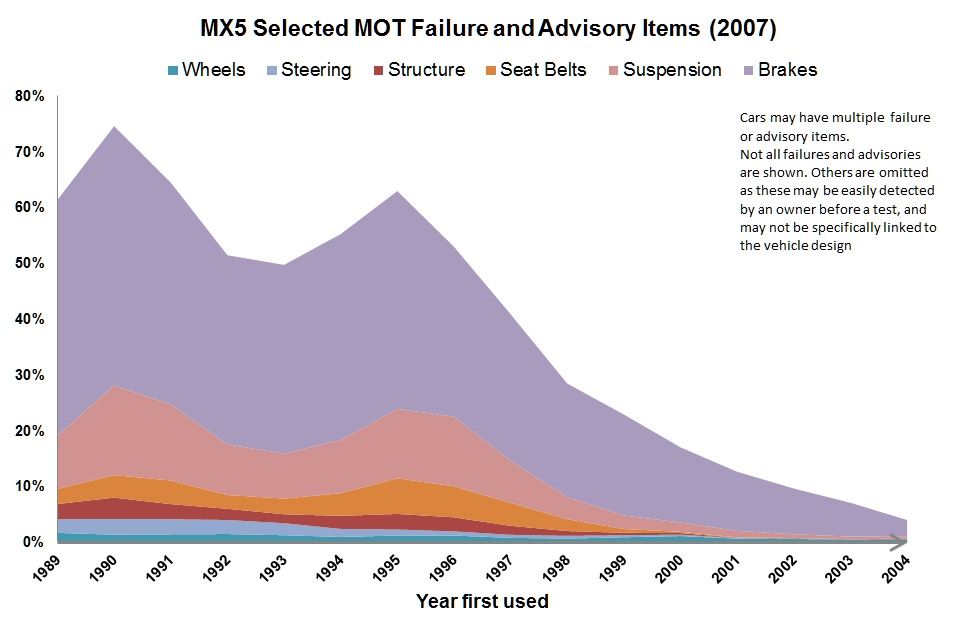
Generally, the weak spot for the MX5 (where they are worse than the average) is suspension failure (coil springs) and brakes (especially handbrake efficiency). Its hard to know if model year to model year variation is particularly meaningful (except that, on average, older MX5s are more likely to fail than newer ones).
Is it possible that some manufacturers worry less about corrosion now because mechanically most cars will go for well over 100,000 miles and if they never rusted they would just last too long? In their ideal world all cars would be replaced with new ones after about seven years.It seems like some give us poor mechaics and others poor bodies etc.
Actually speaking to my Volvo sales guy who I am friendly with he says people are now dumping cars at around 3-3.5 years in comparison for Volvo averages was not long ago 7 years.
Volvo is somewhat unusual; a couple of years ago, Volvo was on its knees, and is now Chinese owned. I suspect traditional Volvo owners are voting with their feet, fairly or unfairly.
PSA seems to be hot for the next car company to collapse, and Renault not far behind it. Both are suffering staggering losses as their EU markets disappear. Renault is apparently kept afloat by Dacia.