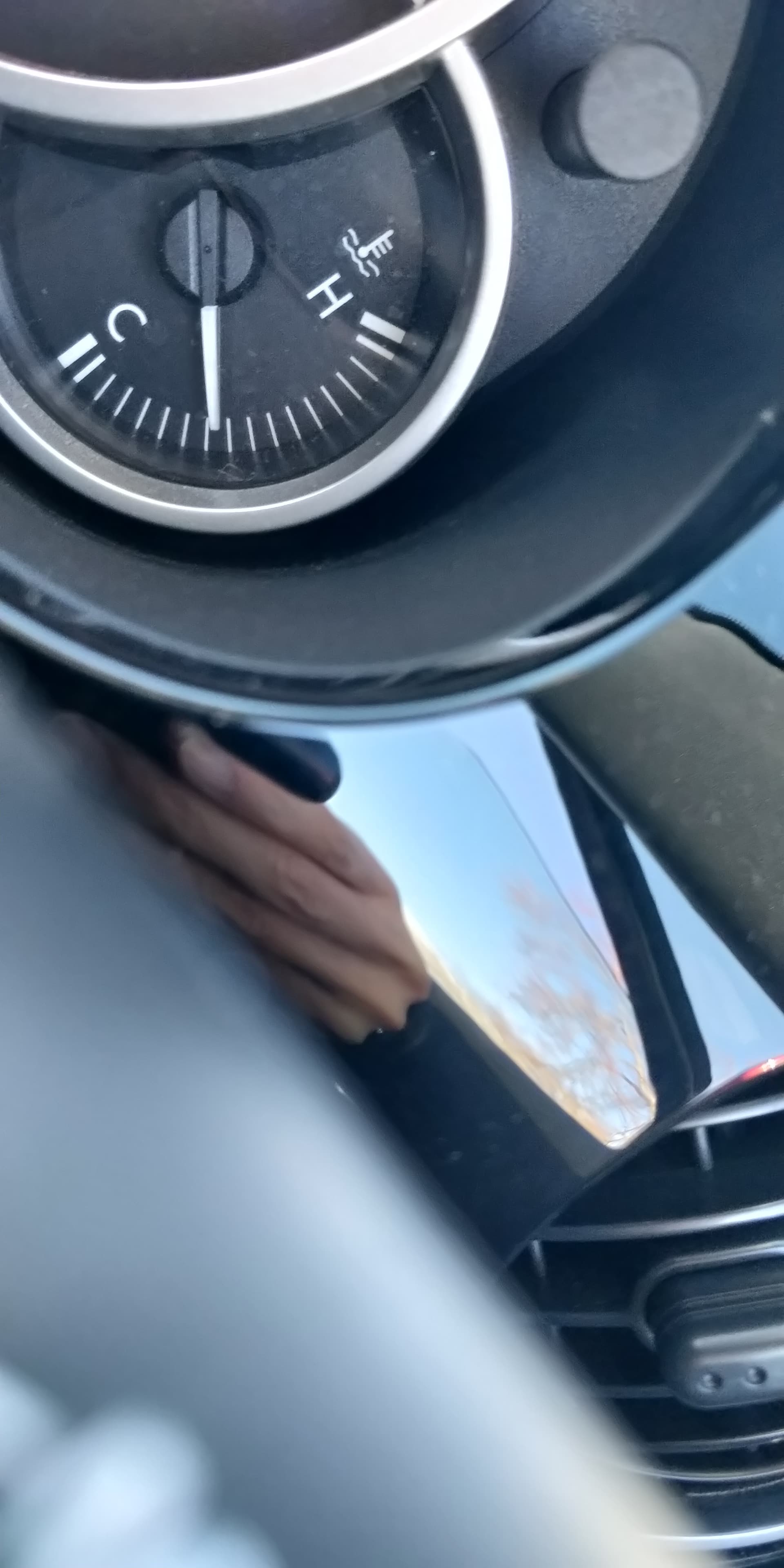
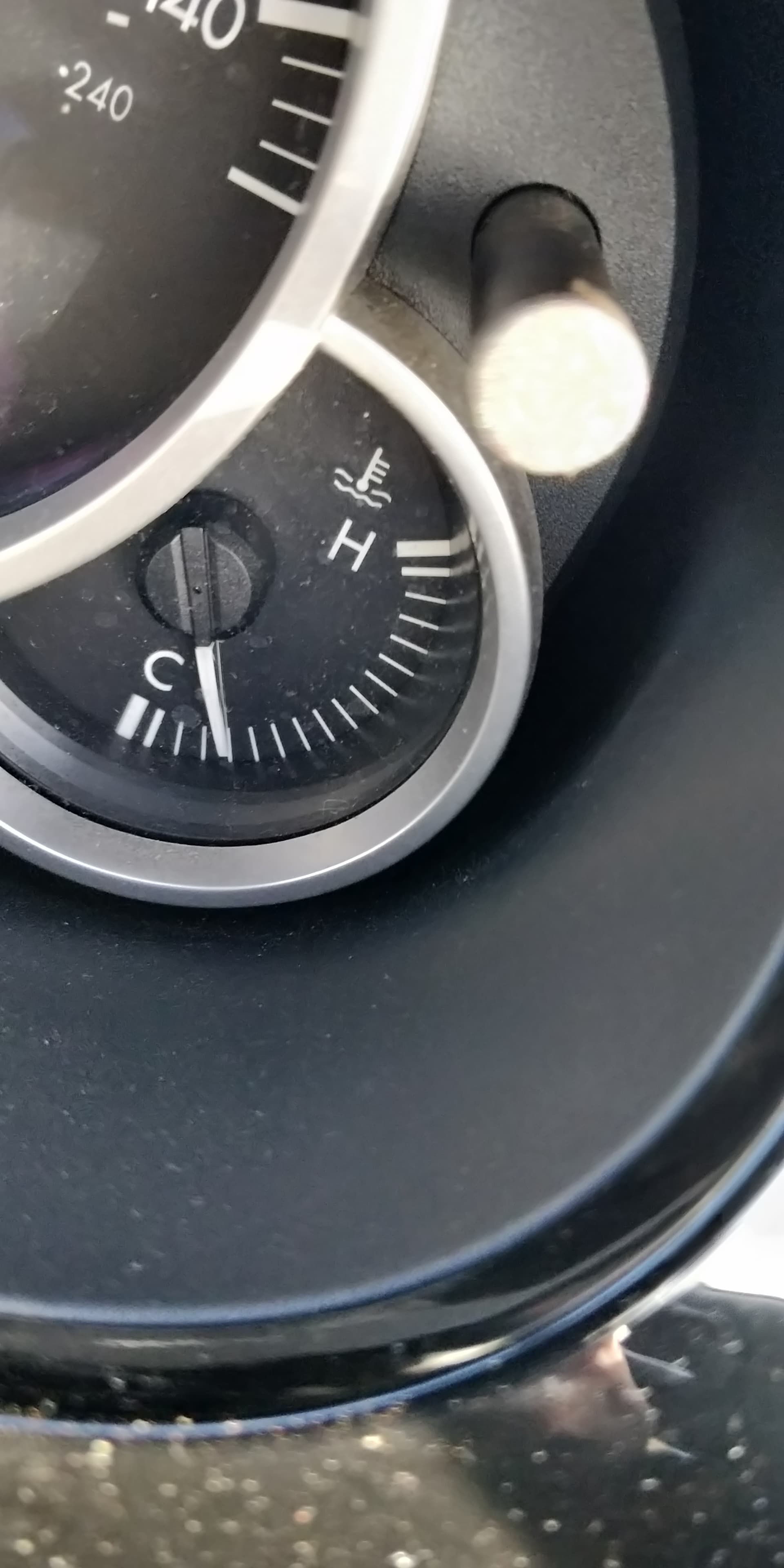
does the needle fluctuate as the car is running (once warmed up) - ie increasing in temperature as the car is not moving and decreasing slightly was the care is moving - I’m not talking ablut large fluctuations but just enought to seethe needle move?
How many miles has the car done? is it a 2.0l?
I had the symptoms I have noted at around 75,000 miles, I spoke to a fellow member who had the same (at a similar mileage) and he’d changed the thermostat, so I change the thermostat on mine and no issues since. (now on 112,000 miles used daily)
When changing the thermostat there are 2 types for the 2.0l - I’m not sure about the 1.8l - the chassis number should define which one, but they are visually different with one having longer hose connection than the other. Also once re fitted and topped up with the correct coolant (it should, I think, be FL22 - check on the top of the expansion tank cap) then there is a procedure on how to bleed the system.
Below is taken from the Mazda Service Manual.
Engine coolant capacity (approx. quantity) 7.5 L {7.9 US qt, 6.6 Imp qt} 1. Remove the cooling system cap. 2. Remove the radiator drain plug and drain the engine coolant into a container. 3. Flush the cooling system with water until all traces of color are gone. 4. Let the system drain completely. 5. Tighten the radiator drain plug. Tightening torque 0.8-1.5 N.m {8-15 kgf.cm, 7-13 in.lbf}
6. Referring to ANTIFREEZE SOLUTION MIXTURE PERCENTAGE TABLE , select the correct volume percentage of the water and coolant. ANTIFREEZE SOLUTION MIXTURE PERCENTAGE (EXCEPT FL22 TYPE ENGINE COOLANT) Engine coolant protection Volume percentage (%) Water Coolant Gravity at 20°C {68°F} Above -16°C {3°F} 65 35 1.057 Above -26°C {-15°F} 55 45 1.072 Above -40°C {-40°F} 45 55 1.086
7. Refill the coolant into the coolant reserve tank up to the F mark on the tank. 8. Install the cooling system cap.
CAUTION: ? If the water temperature gauge rises too high, stop the engine and decrease the water temperature to prevent overheating. Then, verify the malfunctioning part and repair or replace it. ? If the engine coolant level in the coolant reserve tank is below the L mark during engine coolant air bleeding operation, stop the engine, and after the engine coolant temperature decreases, add engine coolant. Then, resume the engine coolant air bleeding operation.
9. Start the engine and warm up the engine by idling. 10. After the engine warms up, perform the following steps. At this time, be careful of the coolant temperature to prevent overheating. 1. Run the engine at approx. 2,500 rpm for 5 min . 2. Run the engine at approx. 3,000 rpm for 5s , then idle. 3. Repeat step 2 4-5 times. 11. Stop the engine, and inspect the coolant level after the coolant temperature decreases. If it is low, repeat steps 7 thru 10. 12. Inspect for engine coolant leakage.
Hi Nick,
many thanks for your prompt and very helpful reply.
Yes the needle does fluctuate slightly when warmed up.
the car is a 1.8i and has completed 62,000 miles.
I see from MX5 Parts there a number of different thermostats.
Where is the thermostat located?
Thanks again.
Regards,
Chris
By the last question asked I think this is a garage job if you are not 100% happy with DIY and this must be done 100% correct to stop any overheating issues.
No prizes for taking on something that is outwith your knowledge base unless you have an experienced person handy to guide you through the first time you do it.
I agree with all Drumtochty said above, but would add a snippet of info which may prove useful if anyone has the same issue…like I did!
When I changed the thermostat on my 2.0L Sport (NC1) it proved a PITA to fully bleed the system afterwards…until I found that putting the car ‘nose-up’ on my neighbour’s sloping driveway (mine’s almost flat) got rid of the bubble of air trapped in the system.
First time ‘burp’ after going ‘nose-up’ - and job’s a good 'un !
Front wheels on a set of ramps would achieve the same onject, I guess…
the thermostat housing is - looking at the engine from in front of the car - located on the right side of the engine towards the front and under the intake manifold - follow the large diameter coolant hose from the bottom of the radiator. It is fiddly to get to and if you’re not 100% confident, as Drumtochty says get a trusted garage to change it. When you buy the thermostat housing it come complete with the thermostat built in.
i was considering this on sunday as i drove to the rally, i traveled approx 110 miles each way and my gauge sat at 1/3 of the way up.
the heater was fine , hot and cold so decided everything must be ok.
Hi, I run a 2011 Mk 3.5 and the temperature gauge sits at 1/3 all the time. Warms up within a mile or so at normal operating temperature after 10 minutes. The 3 cars I tested before buying this car all had a similar reading.
I had the Aircon refreshed a couple of months ago and the car was left idling for 15 minutes and the gauge stayed at a 1/3 and you could hear the cooling fan cutting in and out as required.
Hope this helps. As long as its registering and staying below 1/2 I don’t there is a problem.
My last car a 2.5 Euphonic used to sit at 1/2 way and move towards the 3/4 when in traffic on hot days before the fan kicked in.
I would put it down to a characteristic of the vehicle.
If you spend a fiver on a Bluetooth adapter (Ebay) to plug into the OBD2 port below the steering wheel and download a suitable app, you can find out what the ECU thinks the temperature is.
Just to update everyone.
I have now had a new thermostat fitted under warranty, the needle is higher now ant it all warms up much faster.
Thanks to all of your help in resolving this problem
Best regards,
Chris
And from cold engine, even 5 mins after ignition at idle rpm, the needle is not moving a bit from C. It’s only when I drive around for like 5 mins plus it starts rising.
I just changed thermostat. Before change, on motorway, the need is almost at C LoL.
The gauge should read as in the 1st picture when the engine/coolant has reached what is considered operating temperature. If this is taking longer than approx 5 mins of driving or if the gauge drops then it’s obvious you have a faulty (non working stat) The indicator in the gauge shouldn’t move from that in the first picture, whether banging down the motorway at 70mph or idling at a stand still.
As in the other thread, if it’s still not behaving correctly then you have air in ghe system, a blockage or faulty (new) stat.
Put the heat on full and squeeze the heater hoses. Same with the top hose but not with the engine running👎
As suggested put the front higher to expell the air in the system.