Tyres van how old (how do I identify the date stamp) and when to replace (they have tons of tread but are getting old ) sub 70mph van.
Also how do economy and noise level ratings work
Any views gratefully received ta.
Dave
https://www.protyre.co.uk/car-help-advice/how-to/identify-the-age-of-a-tyre
Just because it’s a camper makes no difference, same applies change tyres on age rather than waiting to wear them out.
I’ve just changed my daily driver tyres, over 6 years old this year, I couldn’t wear them out. They were well overdue anyway, started cracking at 4 years old but deemed safe at the last couple of MOT’s.
As an ex touring caravan owner I’ve seen first hand the carnage it causes when a van tyre let’s go. Seen so many over the years at the side of the road, yep the tyres have let them down.
1 Like
Kwik Fit sum it all up nicely here: How Old Are My Tyres and there are lots of other sites that will tell you similar.
Economy & noise, the nearer to A the better. Can’t speak for economy as it would take effort, but the most recent tyres I put on my car were noise rating E and I can tell why. Not obtrusive, but louder than the (cheaper, poorer quality, but C-rated) originals.
Our van, a VW T4, has had reinforced Continental Vanco Contact 2 205/65 R15 T (99), and variations thereof, fitted since we took ownership of it in 2010. They’ve never lasted long enough to get ‘old’ due to punctures and the miles we do, but if they were 4-5 years old I’d replace them, The spare is now 10 years old and never been used, but I’d only ever use it to get to the nearest garage. It’s such a big lump I’d especially not want a tyre to go at any speed.
1 Like
My mothers car passed an MOT with the original tires (think it was also MOTed before she got it).
We were assured on querying that the tires were fine because they still had good tread, and no cracks etc.
The car wasn’t actually driven at all (it went on a low loader for its first MOT with her as owner since there was a brake problem) so it didn’t matter too much but I personally never liked the dullness of the rubber and I thought they looked too old for safe use, so I kept suggesting she get them replaced since they were well over 5 years old and I had read online 5 years is really when you should start considering replacement.
Anyway for safety she had them changed by a mobile tyre fitters through blackcircles, the tires may have been passing MOTs, but the interior of them had disintegrated and the whole tire was collapsing from the inside out.
The tires were 48 years old 
2 Likes
Is it a fairly recent VW? If so, there’s a wealth of information on here;
https://www.t6forum.com/
No it’s not recent a1985 T25 !
Thanks though.
Many insurers will not cover you if your van tyres are older than 7 years. This is due to various historical incidents due to old tyres and vans doing low milage. So basically if your tyres have a 14 or lower DOT code you will have to change them regardless of condition. You can also get specific Campervan tyres which may have a duel speed rating but often have a different carcase construction designed for the amount of standing around these things do and more UV protection to stop the rubber degrading. Even more wet field tread pattern. However, unsurprisingly they cost rather more than “normal” van tyres which are quite acceptable providing the load rating is appropriate. Something to note, no mater how nicely you ask, your tyre supplier will not be able to request “latest tyres” or buy specific DOT codes as the logistics (and economics) of doing so is just not possible. Finally the Internet has placed far too much significance on these with many customers asking, if not demanding tyres made “last week.” Firstly the logistics of this is just not possible. The manufacturing prices and supply chain lead times can result in even the newest tyres being 6 months old before they even come to market and then tyres correctly stored do not degrade in any significant way before seeing the road even after 2 or 3 years and it is quite normal to receive tyres direct from the manufacturer of that age.
1 Like
Good morning and hope you are well and just thought I would add this to the pot.
I don’t disagree with you in the main.
Caravan tyres generally being the main culprits.
Safety is the most paramount issue of course.
However, you say that tyres will need changing at DOT 14 (i.e the year of manufacture) 7 years old and do not start to degrade, (if stored correctly) until fitted and can arrive at the depot for example 2-3 years old and quite normal.
(Yes I know that maybe your example 2-3 years may be extreme).
Many insurers will not insure if over 7 years old.
To me that is sort of a double whammy.
That does not fit or bode well with the customer for obvious reasons. (Hence why they want the newest made tyres).
As if the insurer “may not” insure the vehicle if the tyres are over 7 years old, you are saying the customer ”Potentially" would only get 4 years of service life from the tyres regardless of mileage instead of the quoted figure of 7 years?
As you say that the tyres do not start to degrade until fitment, then should the customer, insurer and tyre industry not take the “7 year period” from the date of fitment by proof of receipt?
The tyres will get checked at every MOT test.
A good check, but not definitive perhaps.
In my opinion you either have to stick with the date of manufacture or the date of fitment perhaps.
Perhaps email the tyre maker and ask them what the service life is for insurance purposes.
Every vehicle/tyre will have different circumstances of course.
Just food for thought. 
Thank you all very much for the replies, very interesting and food for thought. I fear the date code on my van tyres may be in Roman numerals  as I can’t remember the last time tyres were fitted and we have had the van 19 years! Rapidly coming to the conclusion it’s time to spend some folding stuff! As an aside many years ago I was driving my wife’s car on a motorway and noticed a rythmic bouncing from the back of the car (which she had bought new before we met), upon inspection I found a bulge on the inner wall of one of the rear tyres like half an egg, when the tyre fitter looked the date stamp tied up with the age of the car, so, about 13 years and 97k miles ! 1 careful lady owner never raced or rallied
Again thanks to all for your replies and help.
Kind regards Dave.
Blimey, you have had your money out of them and been very lucky!
Enjoy and all the best. 
Your not wrong there my friend and thank you.
Regards Dave.
1 Like
With my old Astra 1.4SE doing 20-22K a year on the M25 I changed the back tyres at 120K miles not because the OEM Continentals were worn, far from it with 4-5mm of tread, but because the outside sidewalls were starting to perish (no cracks anywhere). The front tyres only lasted 40K each time.
1 Like
Good morning to you too.
The thing is, it does not matter what you or I think, that is the reality of the situation.
Some years ago I took young children to a colliery that was now a museum. The tour guide, a former miner told stories including about the mine working regulations calling them “a book of blood” and that every rule that had come about had been because someone had died first. In the same way I fully expect the insurance industry issue with tyres of greater than 7 years is not because they thought it would be a good idea one morning, but because more than one situation will have occurred with campervans being spread all over various motorways with the inevitable resultant nastiness that goes with that.
Again, in what feels like a different life time, I used to run this company. When you see the scale and speed of tyre manufacture, logistics and distribution, even before it comes to fitting, there is no economical process to grade tyres by age.
Apologies, but I can’t attach a PDF so it is only screen shots.



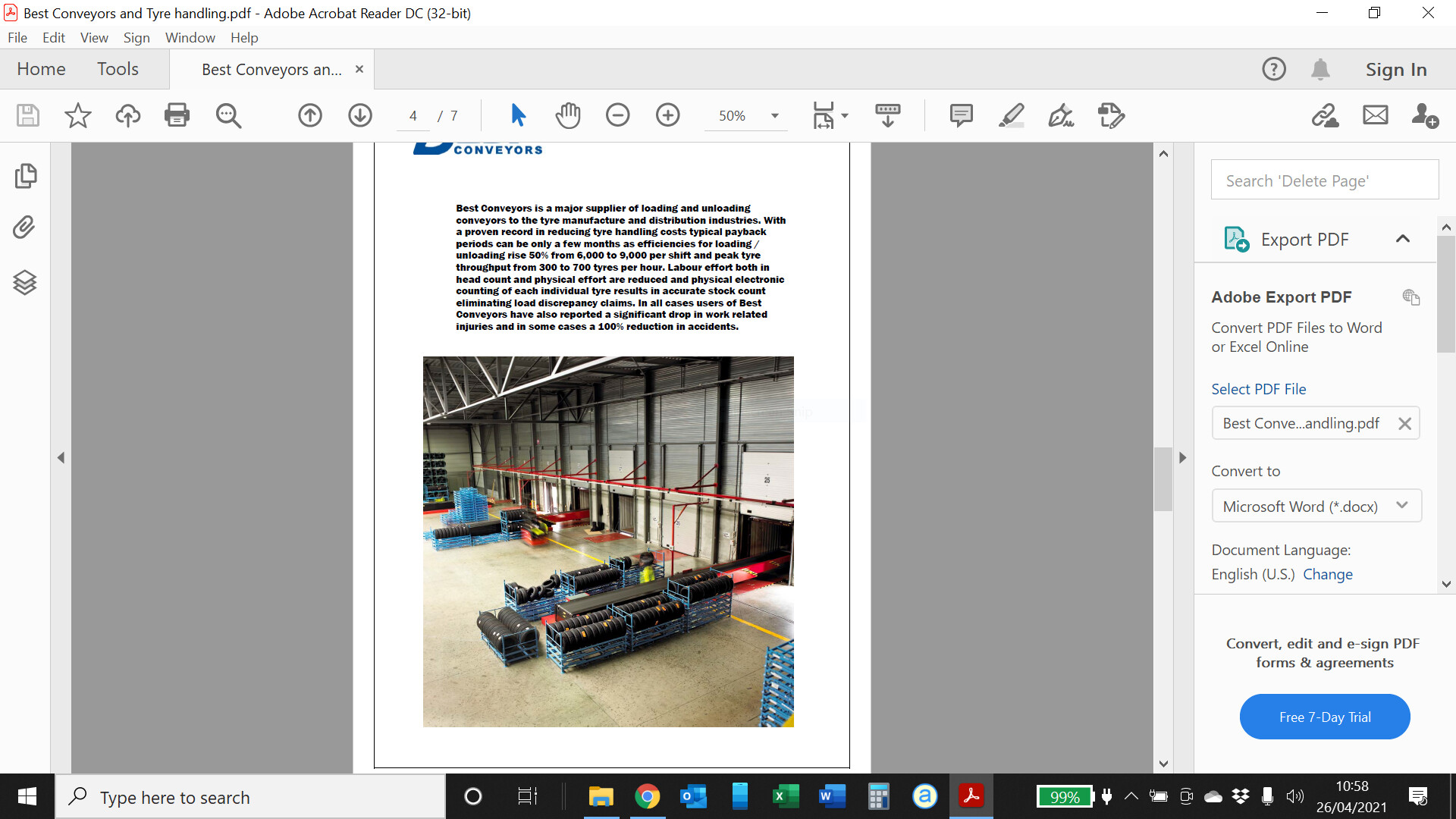



The upshot being, tyre manufactures put manufacturing dates on their tyres and insurance companies go by that.
It is a pretty common thing to change tyres of that age at National Rallies “but they have plenty of tread on them!” https://photos.app.goo.gl/zz1X5fVRinW17ZkQ8
1 Like
That’s how my Bridgestone’s were going at 6 years old. Cracking on the outer shoulder but loads of tread left.
1 Like
Thanks for the reply. 
Yes, we all know about Motorhome/Caravan carnage because of tyres and I fully agree with your thoughts.
However, where did that come from about insurers not covering (voiding) the policy if tyres are over 7 years on that specific point?
Have read your supplied information and nothing there.
I have been out of the loop for a few years and can’t find anything about that, have I missed something?
I have asked the Association of British Insurers, (ABI) and they state basically as long as they are Road legal with tread, no bulges, no delamination’s, correct fitment, size, cracking etc etc, they will be covered insurance wise.
To check with the individual insurer, which so far they state road legal and no mention of over 7 years.
A tyre older than 7 years doesn’t make it illegal in its own right and therefore would not void the insurance policy.
The recommended industry “practice” for changing them is between 5-7 years as we all know because of cracking etc as above.
Which I completely agree with as my MX5 Bridgestone’s went that way after 5 years with minimal mileage.
Nothing on the MOT side or legislation that I can find either.
There is legislation being proposed for Large Goods vehicles, (H.G.V’s) Coaches etc not to have tyres fitted over 10 years old for obvious reasons.
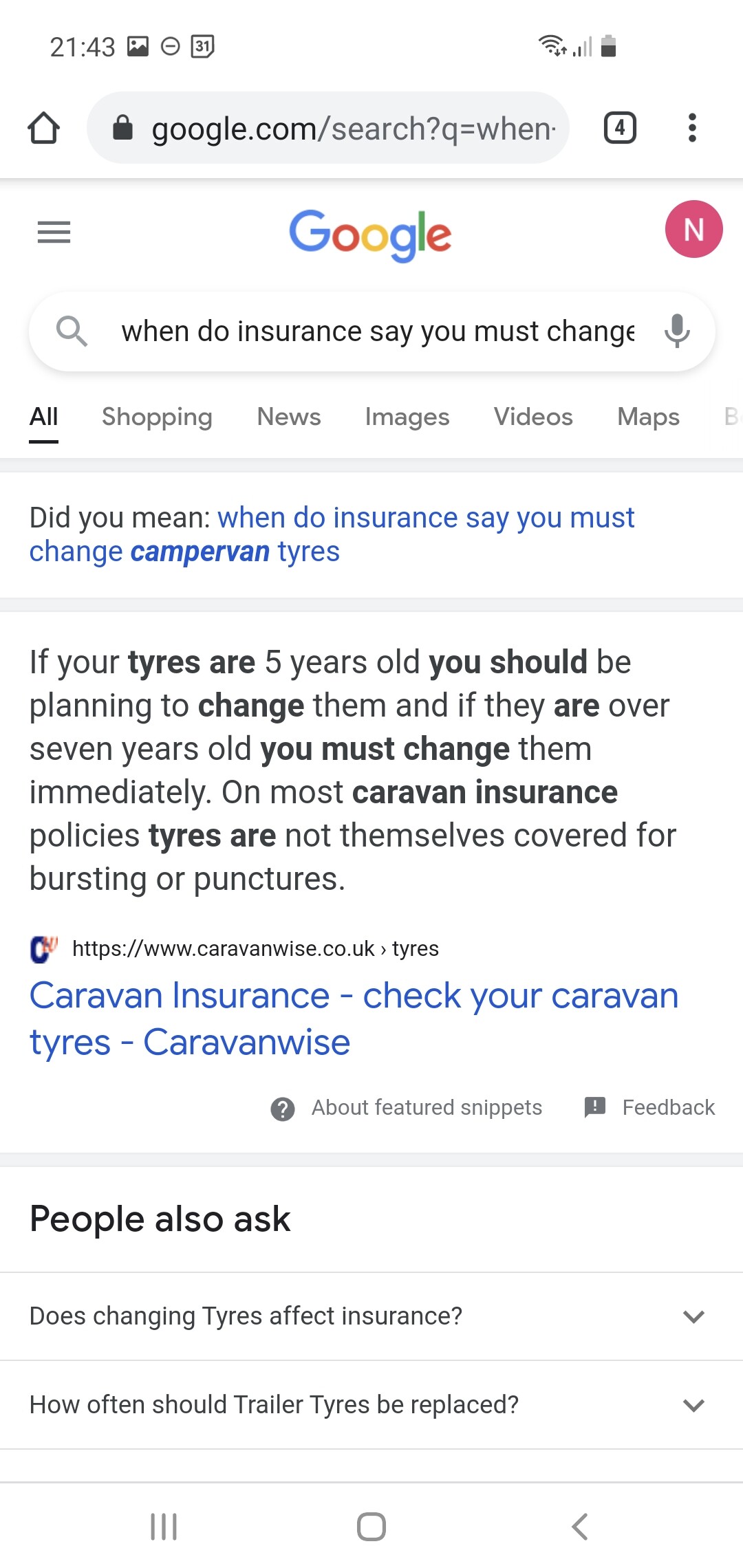
That as I thought ONLY refers to the insurance cover of the “actual tyres if they fail” by the company caravanwise and probably many others.
It does not void the actual whole vehicle insurance.
Many thanks.